
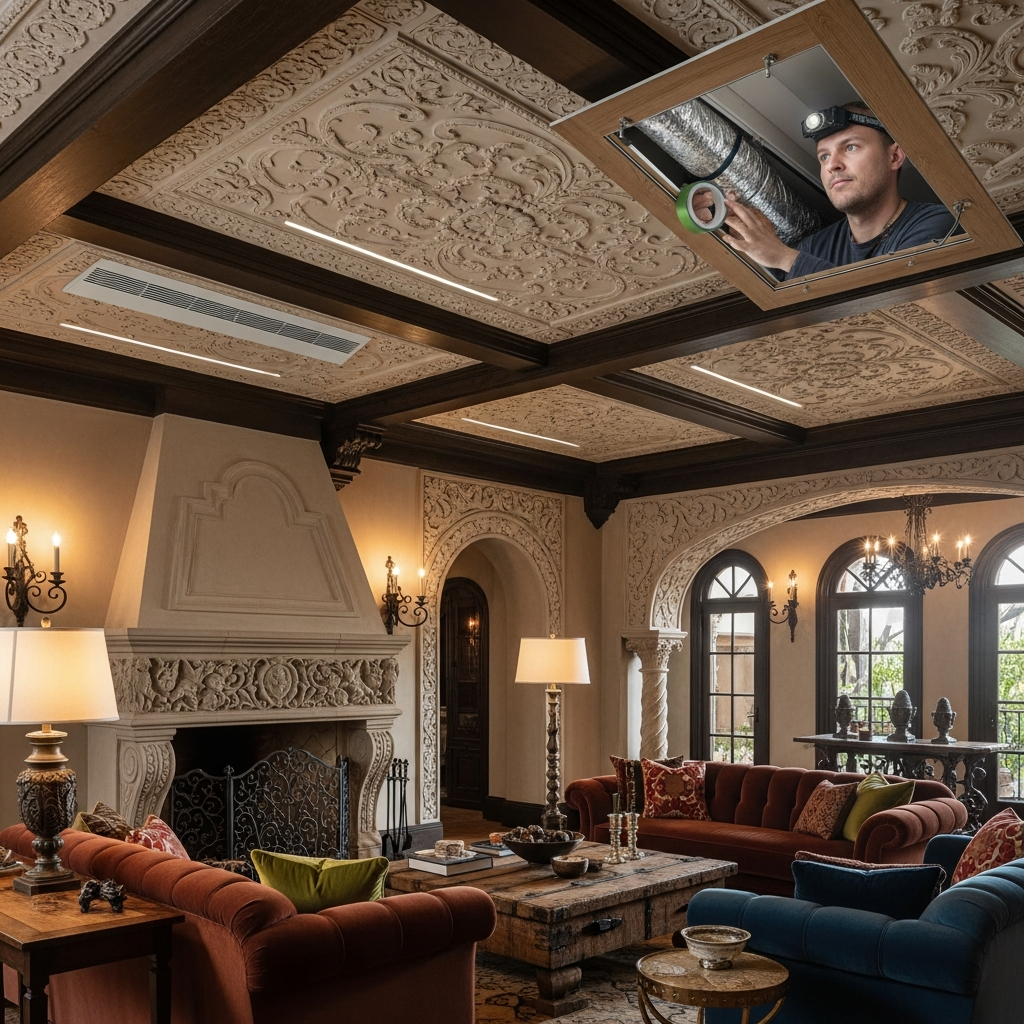
Walk into a classic Beverly Hills home and you immediately sense its history. Arched entries lead to sunlit courtyards, timber ceilings glow with the patina of decades, and hallways reveal additions layered over time. Yet behind those details, many of these residences rely on ductwork that was never designed for the way we live today. If a living room remains stubbornly warm on summer afternoons, if a guest room feels drafty at night, or if the system sounds louder than the soft background hush you expect, the reason often traces back to an aging or improvised duct network. For these older homes, duct replacement is not just a mechanical upgrade; it is a preservation tool that protects comfort, air quality, and the architectural integrity you value.
Our neighborhood’s housing story is a mosaic. Spanish Revival bungalows from the 1920s sit a few blocks from Mid-Century flats, while 1970s remodels and more recent expansions round out many streets. Each era brought its own approach to mechanical systems. Some homes were built before central air was common and later retrofitted with whatever pathways could be created at the time. Others received duct additions when rooms were annexed or garages were converted, often with branch lines tacked onto a trunk that already worked hard. Over time, materials aged, insulation sagged, and tape dried out in the attic heat. What remains can be a patchwork that barely resembles a designed distribution system.
The challenge of legacy layouts
Old homes often carry hints of the original design’s priorities: formal entertaining spaces, shaded verandas, and thick plaster walls that buffer sound and temperature. When ducts were added to such structures, they sometimes took the path of least resistance, threading through tight attic spaces or sharing chases with plumbing. Those compromises are understandable, but they come with costs. Long, winding runs add friction that fans must push against. Sharp turns create turbulence and noise. Returns that are too few or too small starve the system of air, forcing equipment to work harder and louder. Over decades, these quirks turn into persistent comfort problems that no thermostat change can solve.
What replacement accomplishes in an older home
Replacing ducts in an older Beverly Hills property is less about swapping materials and more about rewriting the airflow story. The process begins with a careful evaluation of how rooms are used now. A library that began as a secondary space might be a daily workspace; a small den might have become a primary family room. Each change alters heat gains and expectations. A modern duct design sizes supply and return runs based on those realities, creating an even, responsive system. New trunks reduce static pressure, branches are routed with gentle sweeps, and ducts are sealed with mastic to stop leakage. The result is quieter operation, balanced temperatures, and air that feels freshly delivered rather than forced or stale.
Respecting architecture while improving performance
One of the hesitations homeowners voice is the fear that mechanical work will scar irreplaceable finishes. In practice, a thoughtful replacement plan shields character while updating function. Access is often concentrated in attics or crawlspaces, with indoor work limited to replacing or relocating grilles. Where visible changes are needed, low-profile diffusers or linear slots can blend with plaster or woodwork. By collaborating on grille placement that acknowledges sightlines and furniture layouts, the upgrade complements rather than conflicts with the home’s original design language.
Why older ducts fall short
Time exposes the weaknesses of earlier practices. Cloth-backed tapes peel under attic heat. Insulation on flexible ducts slumps, turning a round airway into an oval that restricts flow. Makeshift returns carved from joist bays let dust and attic air shortcut into the system. When additions were connected without rebalancing, the primary living areas may have been robbed of airflow to feed new rooms. All of this leads to a system that runs longer and louder yet still struggles to deliver comfort. Replacement resets the baseline, trading those layered compromises for a coherent design tailored to today’s expectations.
Indoor air quality in historic structures
Older homes are often praised for their breathability, but not all infiltration is benign. If return ducts leak in an attic or crawlspace, the system draws unfiltered air laden with dust, insulation fibers, or soil odors. Conversely, supply leaks depressurize the home, pulling outdoor air in through gaps around windows and doors. That uncontrolled exchange is not the same as fresh ventilation. New, tightly sealed ducts ensure that every cubic foot of air is filtered before entering living spaces. Pair this with an upgraded filter cabinet and you will notice less dust on surfaces, clearer air, and a more neutral indoor scent that respects the home’s materials rather than masking them.
Sound and serenity
Many older homes developed a reputation for noisy HVAC because the duct systems were undersized for modern equipment. Fans working against high static pressures produce whistling grilles and rumbling plenums. Replacement confronts this head-on by sizing ducts for the target airflow and by choosing registers that distribute air at comfortable velocities. Gentle duct geometry reduces turbulence, and strategic use of lined plenums or flexible connectors at equipment helps absorb vibration. The payoff is a system that fades into the background, letting the home’s charm take center stage.
Adapting to additions and layered renovations
In Beverly Hills, few homes escaped change. Sunrooms became offices, patios enclosed into breakfast nooks, or second stories added for growing families. If each change attached to the existing ductwork without a whole-home redesign, the result may be a lop-sided system. Replacement provides a clean slate to integrate all wings equitably. With balancing dampers accessible for fine-tuning, technicians can dial in airflow so that newer spaces no longer steal comfort from original rooms. Zones can be planned to reflect how you actually move through the home rather than how the floor plan looked decades ago.
The comfort dividend you will notice
After replacement, homeowners usually describe the same moment of recognition: a sense that the home finally matches the thermostat setting without effort. The dining room no longer needs a sweater; the main bedroom is as pleasant at dusk as it is at noon. Air streams into rooms with a quiet steadiness instead of gusts. You become less aware of the system and more aware of how easy it is to host, rest, and focus. For a house with strong personality, that comfort dividend elevates daily living without calling attention to itself.
What the process looks like
A well-run project starts with measurement. Technicians assess existing ducts, note constraints like low-clearance rafters or vintage built-ins, and model airflow to determine ideal trunk sizes and routes. Work is sequenced to protect finishes, with pathways covered and dust carefully managed. Sections of duct are removed and replaced methodically, with tests at milestones to confirm design targets are met. At the end, balancing aligns delivered airflow to each room’s needs. From the homeowner’s perspective, the process feels organized and respectful of the house, with clear communication about timing and room access.
Case notes from the neighborhood
On a quiet street near Roxbury Park, a 1930s home had absorbed two additions and a garage conversion. Summer parties pushed the system to its limit, with the den always several degrees warmer. Replacement introduced a new trunk serving the expanded footprint, a secondary return to relieve static pressure, and registers chosen for throw across the den’s seating area. After commissioning, the homeowner described the result as effortless: guests could sit anywhere without hunting for the cool spot. In a Trousdale Mid-Century, tight rooflines constrained plenum space. By designing flatter, wider duct sections and using careful sealing, we achieved low static pressures that made a modern heat pump whisper-quiet. These are the kinds of practical victories that replacement makes routine.
Planning for fresh air and filtration
Older homes benefit when duct replacement anticipates better filtration and, where appropriate, dedicated fresh air. With sealed returns and supply runs, a filter cabinet can finally see the full system airflow, making upgraded filter media effective rather than theoretical. During smoky periods or high pollen days, the system is ready to protect indoor air without straining. Even if fresh-air integration is a future step, laying out ducts with room for that addition keeps your options open without future tear-outs.
Midway motivation
Halfway through many projects, when temporary registers are in place and the new trunk is live, the character of the home starts to change. Spaces feel calmer and more consistent, as if the walls themselves were quietly cooperating. If you are weighing the decision, it helps to imagine that moment and the daily ease it unlocks. That is what thoughtful duct replacement delivers in older Beverly Hills homes: a renewed foundation for comfort that respects history while serving the present.
Frequently asked questions
Will duct replacement harm my home’s original finishes? A careful plan and experienced crew protect plaster, millwork, and floors. Most work occurs in attics or crawlspaces, with interior touchpoints limited to grilles and access panels that are patched to blend seamlessly.
How do I know if my older ducts are the problem? Signs include uneven room temperatures, lingering dust, musty odors when the fan starts, and grilles that whistle or rattle. A professional evaluation that measures static pressure and checks for leakage provides a clear diagnosis.
Can I keep my existing equipment? Often, yes. Many older homes see major comfort gains from improved duct design alone. A candid assessment will clarify whether your current system can thrive with new ducts or whether a coordinated upgrade makes sense.
What about historic preservation rules? Requirements vary. The good news is that duct replacement typically focuses on concealed spaces and reversible components. With thoughtful planning, performance can improve without altering protected architectural elements.
How long will the benefits last? Properly installed and sealed ducts provide long-term reliability. With routine filter changes and periodic checkups, the system should serve comfortably for many years.
Will new ducts be quieter? Yes, when they are sized and routed to keep static pressure low and velocities appropriate. The difference is often immediate: air arrives as a calm presence rather than a rush.
Make your classic home feel effortlessly current
Your home’s character deserves comfort that matches its beauty. If you are living around hot spots, drafts, or a system that sounds busier than it should, a fresh look at the distribution network can restore ease without sacrificing style. Start a conversation about a design that respects architecture and optimizes airflow for how you live now. When you are ready, connect with a local team and explore how duct replacement can renew an older Beverly Hills home from the inside out, so every room feels naturally, quietly right.