
Clean Air, Clear Minds: The Office Advantage
Walk into a Beverly Hills office where the air feels naturally fresh, and you can sense it right away. Conversations move easily, meetings feel focused, and the space carries an energy that comes from comfort rather than effort. As a local HVAC professional supporting commercial properties across the Triangle, along Wilshire and Santa Monica Boulevards, and in tucked-away creative suites, I have watched teams become noticeably more productive once their indoor air system is tuned and clean. The change is not dramatic on paper—it is felt in the way people think and work throughout the day.
Commercial buildings promise comfort, but day-to-day realities complicate delivery. Tenant improvements re-route ducts, office reconfigurations alter airflow, and occupancy varies by hour. On top of that, our local climate brings seasonal winds and occasional regional wildfire smoke, adding ultra-fine particles that can infiltrate envelopes and linger in return paths. A disciplined approach to air duct cleaning makes your building’s baseline healthy again, ensuring that what circulates above the ceiling tiles supports productivity rather than undermines it.
Why Office Duct Cleaning Matters
Indoor air moves in loops. Air is drawn through returns, filtered, conditioned across coils, then supplied back to occupied zones. If dust and debris have accumulated in ducts or across coils, each cycle can reintroduce particles to the workspace, prompting more frequent cleaning, increased complaints about stuffiness, and even hot-cold disputes as the system strains to move air. In open offices, dust re-suspends easily from foot traffic and work surfaces, finding its way back into returns once the system ramps up.
When the ductwork and mechanical core are clean, filters stop playing catch-up and start working as intended. The results are tangible: clearer air under bright office lighting, fewer dust streaks at supply vents, and a steadier acoustic profile as fans operate at lower intensities. Managers often notice fewer comfort tickets and a more even temperature feel across zones—small improvements that add up to a calmer, more productive day.
The Beverly Hills Building Context
Beverly Hills offices range from boutique suites in older low-rise buildings to polished floors in modern towers. Many spaces have layered histories—past tenant layouts, successive build-outs, and HVAC equipment updates that did not always include a full duct reset. Supply branches may have been capped, split, or elongated; returns sometimes sit far from where people actually gather. Add episodic dust from renovations down the hall or from new neighbors above, and it becomes clear why even a tidy office can feel intermittently dusty.
Our city’s climate intensifies these variables. Dry periods and wind events carry fine particulates that make their way inside through micro-leaks or during busy move-ins when doors remain propped open. Once inside, these particles follow the path of least resistance into return ducts. Over months and years, they become a persistent source unless proactively removed.
How a Professional Office Duct Cleaning Works
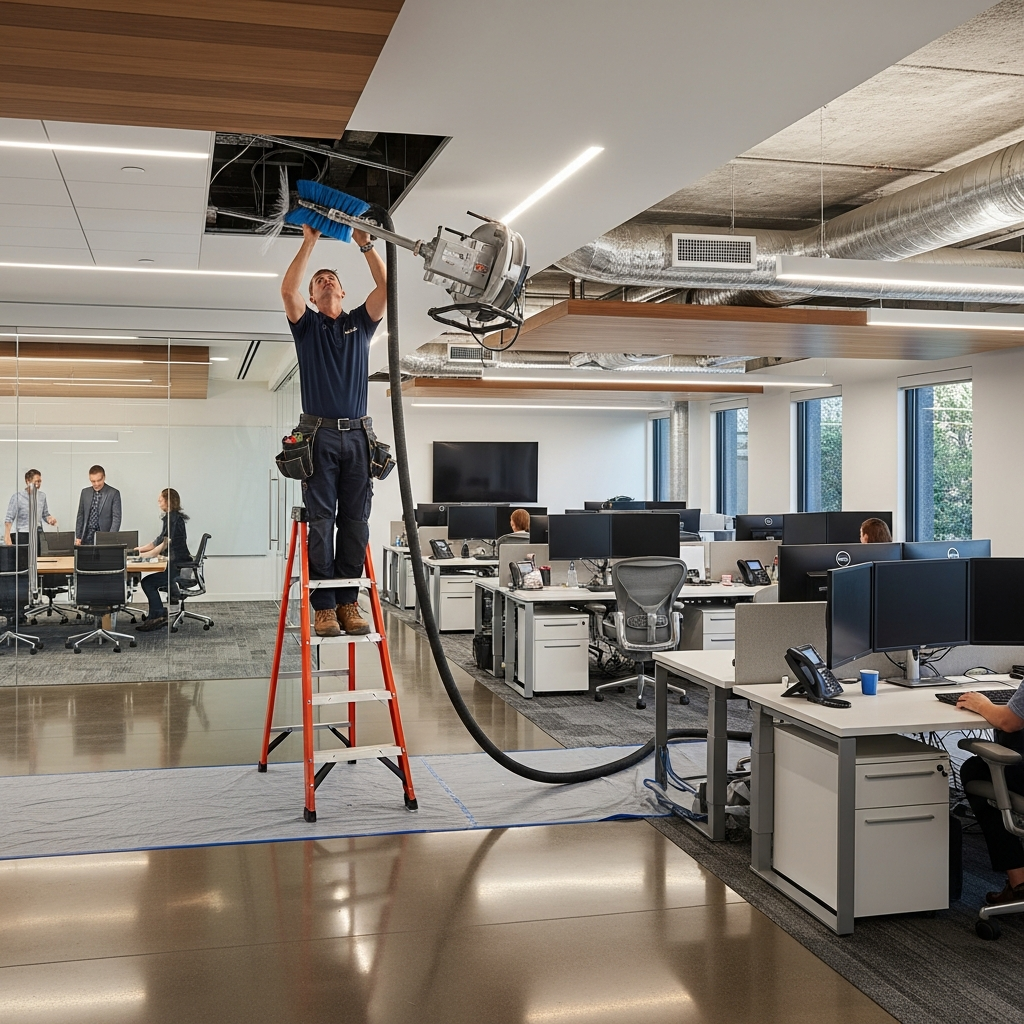
We start with a survey: ceiling plenum conditions, return locations and sizes, filter cabinets, coil cleanliness, and the layout of supply branches by zone. We speak with facility managers and tenant contacts to understand comfort hotspots and times of day when complaints peak. With that map, we stage containment and use high-filtration negative air equipment so disturbed debris moves toward capture, not into occupied areas. Agitation tools matched to duct materials loosen settled dust along branches and risers, while registers and grilles are cleaned and reinstalled.
Attention to the mechanical heart is non-negotiable. Coils and drain pans influence everything downstream. A dusty coil sheds fine particulates and reduces heat transfer efficiency. Cleaning these components, along with the blower cabinet, returns the system to design intent. Where building policy allows, we evaluate filter type and cadence, recommending solutions that balance capture with fan energy and static pressure.
Scheduling Without Disrupting Work
Commercial life follows a clock. We plan work after hours, on weekends, or in carefully staged phases so tenant operations continue without interruption. In occupied suites, we coordinate with office managers to secure work areas and protect equipment and files. In common areas and risers, we post notices and work with building engineers to manage access. The result is a service that feels nearly invisible except for the difference it makes the next business day.
Communication is as important as the cleaning. Before work begins, we share a plan with stakeholders, including the sequence by zone, estimated durations, and protection methods. Afterward, we provide clear documentation—photos, readings, and any recommendations—so building staff has a record to reference during future maintenance or tenant improvements.
Outcomes You Can Measure and Feel
After a thorough cleaning, many offices report immediate improvements. Dust films fade from desks and monitors, and supply vents stop accumulating gray streaks. Meeting rooms feel less stuffy during long sessions, and open areas maintain comfort with fewer “hot seat” complaints. Fans often run at lower speeds for longer periods, softening the sound profile and creating a more consistent environment. Over the following weeks, custodial teams spend less time battling reappearing dust and more time keeping shared spaces polished and ready.
Airflow balance also improves. When ducts are free of accumulation and dampers are returned to intended positions, zones stabilize. This helps resolve the tug-of-war between colleagues adjusting thermostats or space heaters. Comfort ceases to be a daily debate and returns to being the background condition that supports good work.
Mid-Project Adjustments That Make a Difference
During cleaning, we often discover small issues that cause outsized frustration: a damper stuck half-closed behind a ceiling tile, a section of flex with a kink feeding a busy area, or a return that draws more from a corridor than from workstations. We document these findings and, with your approval, correct them. Combined with comprehensive professional air duct cleaning, such fixes provide lasting improvements that tenants notice.
For multi-tenant floors, we coordinate with neighboring suites to minimize cross-impact. Pressure differentials between spaces can otherwise nudge dust in unexpected ways, especially during after-hours work. A floor-wide plan keeps airflow consistent and results predictable.
Keeping the Gains: Filtration and Policy
After cleaning, filter strategy sustains air quality. We match filter ratings to equipment capability and recommend schedules that anticipate high-occupancy periods and seasonal dust. We help facility teams spot early warning signs—uneven filter loading, bypass streaks, or quick return streaking—that signal it is time to act before complaints rise. For buildings with green goals, we consider energy impacts and lifecycle benefits, selecting solutions that support both health and efficiency.
Tenant communication matters, too. Simple guidance—keeping supply diffusers clear of boxes, reporting rattles early, allowing brief after-hours fan runs post-cleaning—helps preserve the system’s calm. Shared responsibility fosters a workspace where everyone benefits from clearer air.
Frequently Asked Questions
Will duct cleaning interrupt our business day? Not if planned well. We schedule after-hours and weekend work or phase by zone, coordinating with managers so meetings and operations continue smoothly.
How often should an office building schedule cleaning? Many properties benefit from a two- to three-year cadence, with earlier service after renovations, tenant turnovers, or significant wind and dust events.
Can cleaner ducts improve tenant satisfaction? Yes. Offices often see fewer comfort complaints, clearer air under bright lighting, and less reappearing dust on work surfaces—outcomes that support productivity and morale.
Is there a risk to sensitive equipment? We use containment and high-filtration capture to protect electronics and documents. Work areas are shielded, and registers are cleaned and reinstalled carefully.
What documentation will we receive? You will receive photos of before-and-after conditions, airflow readings, and recommendations. This record supports future maintenance decisions and demonstrates care to stakeholders.
Make Your Beverly Hills Office Feel Effortless
If you are ready for a workspace where clean air amplifies focus and teams feel the difference from the first meeting to the last, now is the time to act. Begin with an assessment that respects schedules, tenants, and building priorities, and let us craft a plan that brings clarity back to your air. To explore how meticulous air duct cleaning supports healthier, more productive offices, reach out and set your building on a path to comfort that simply works.