
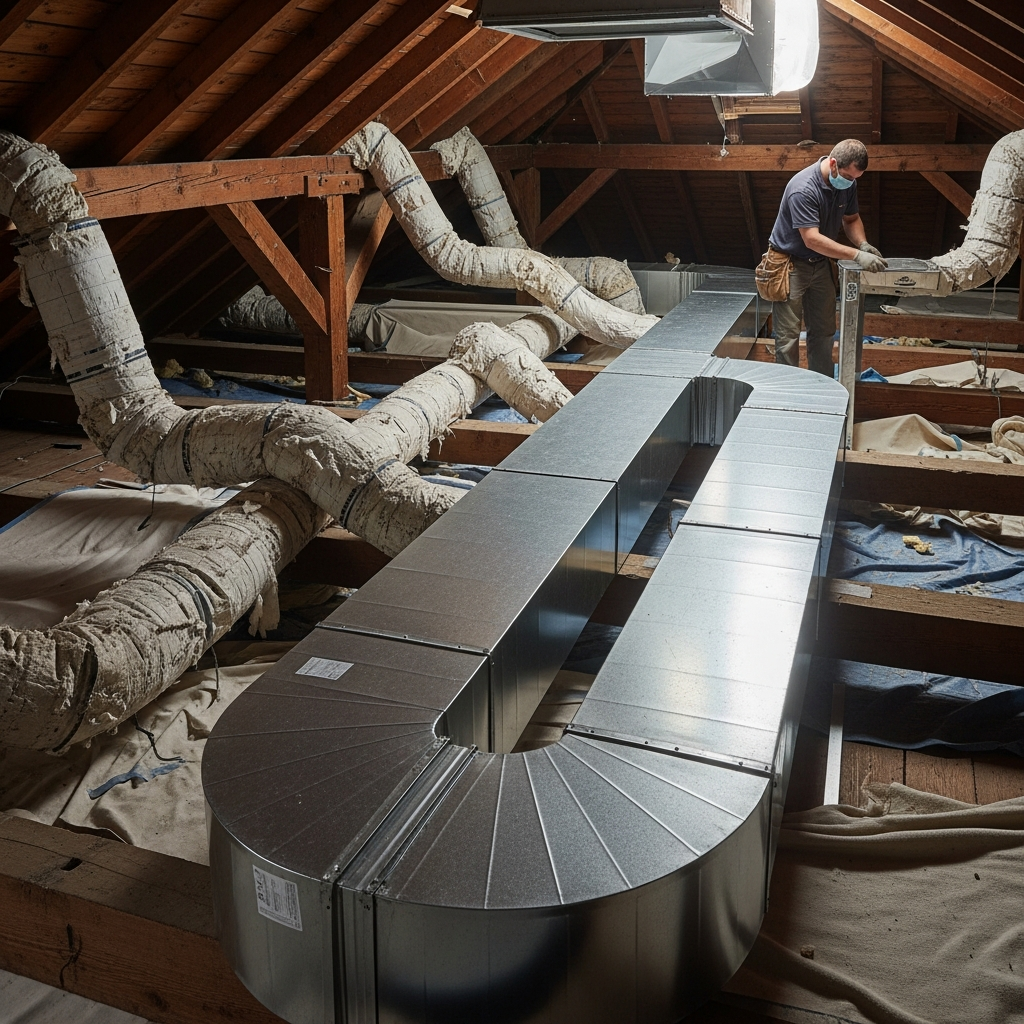
Older homes in Beverly Hills are treasures—timber that has settled into a confident stillness, plaster that glows softly in afternoon light, and details that tell stories with every glance. In these houses, comfort deserves the same level of craft as the architecture itself. Many of these properties rely on ductwork that has done its duty for decades, often using flexible sections that no longer hold their shape or were routed in a hurry during past renovations. When rooms feel uneven, registers hiss, or dust lingers no matter how often you change filters, the culprit may be aging or poorly supported flex duct. Replacing those runs with a smarter blend of materials and methods can return quiet, balanced comfort to the forefront. If you’re starting to explore your options for a Beverly Hills–appropriate plan, it’s helpful to review local guidance on duct replacement so your approach fits the character and constraints of an older home.
Flex duct has its place. Used correctly, short, well-supported lengths can absorb vibration, simplify final connections, and make tight geometry possible without resorting to a tangle of hard elbows. But in many older homes, we find long, sagging stretches where air has to fight its way through flattened sections and awkward bends. Over time, insulation can slump, inner liners can crease, and tape-only joints can leak. In attic heat or crawlspace humidity, these weaknesses show up as rooms that never quite reach the temperature you ask for and a system that sounds like it is working too hard. Replacement is the moment to reset the standard—respect the home’s bones while giving airflow the smooth, stable path it needs.
Understanding the role of flex in a thoughtful system
In a carefully designed distribution network, rigid trunks carry the main load. They hold shape under insulation, resist compression, and create predictable pathways. Flex shines as a connector: the last few feet that allow a register to meet a ceiling or wall without transmitting vibration, or the gentle sweep that avoids a sharp, noisy elbow. The secret is support. Flex needs to be hung at the right intervals, kept taut enough to prevent sagging, and routed with broad, lazy curves rather than tight turns. When those guidelines are followed, flex can be a quiet friend to comfort. When they aren’t, it becomes the bottleneck that frustrates a good system.
Older homes add complexity because access may be limited and existing pathways are often the product of many hands over many years. You might find a register fed by a flex run that snakes around obstacles it never should have had to navigate. You might discover that a trunk was once sized for a smaller home and that additional rooms were connected by simply teeing off in ways that left the newest spaces starved. The art of replacement lies in rethinking these habits—re-establishing a backbone of stable trunks and using short, well-supported flex only where it truly serves the design.
Respecting finishes and preserving character
One reason homeowners hesitate to address ductwork in older properties is fear of disruption. That is completely understandable. Plaster, stone, bespoke millwork—these elements need protection and a gentle hand. A well-run project begins with planning: identifying work zones, staging coverings, and mapping routes that respect what makes the home special. In many cases, we can access attics or crawlspaces without intruding on finished rooms, and where we must enter, we do so with care and communication.
Preservation also shapes register choices and locations. In some historic rooms, a smaller, discreet register style suits the architecture better. In others, relocating a return a few feet creates a calmer acoustic environment without altering the visual language of the space. These are conversations we have together, balancing the home’s story with the practical needs of airflow and maintenance.
Why replacement outperforms patching
It’s natural to want to fix only what’s visibly broken, but flex duct failures are often systemic. A single crushed section may be the symptom of a route that was never right. Tape that keeps peeling back usually hints at a joint that needs proper mechanical fastening and mastic, not another layer of adhesive. Replacing piecemeal can leave you chasing issues around the house. Replacement, by contrast, takes a top-down view—designing a distribution network that suits the home’s present reality and future plans. The results speak in even temperatures, quieter registers, and air that feels cleaner because leakage has been addressed rather than hidden.
For many older Beverly Hills homes, replacement is also a chance to improve return air. Starved returns make noise, throw off pressure balance, and undermine filtration. Adding or resizing returns during the project complements the work done on the supply side, rounding out the system so it breathes with ease.
Craft that shows up in the details
What separates a durable upgrade from a quick fix is attention to detail. Flex runs are kept as short and straight as possible, stretched just enough to smooth the inner liner without stressing it, and supported so their shape doesn’t deform with time. Transitions between rigid and flex are made with proper collars and sealed thoroughly with mastic, not just tape. Insulation is specified and installed to keep supply temperatures where they belong from plenum to register. Long-radius turns replace abrupt elbows, and connections are secured mechanically before they are sealed. These practices aren’t glamorous, but they are the quiet guardians of comfort.
In crawlspaces, we are mindful of moisture and pests. Ducts are elevated off the ground, supports are designed to avoid compression, and terminations are sealed to discourage intrusions. In attics, we protect against radiant heat gain and ensure that ducts aren’t buried in ways that will make future inspections or service a misery. Each decision is made with an eye toward the next decade, not just the next season.
Air quality and acoustics in older homes
Homes built generations ago were not designed for the air quality challenges we occasionally face today. When returns leak or supplies are poorly sealed, attic dust and insulation fibers can hitch a ride into living spaces. Replacement allows us to close those doors, giving your filter the best chance to do its job. Noise is the other side of the coin. Registers that hiss or whoosh are usually telling you about undersized or poorly routed runs. Balancing the system, taming velocities, and choosing register locations that suit the room’s function restore the quiet that older homes wear so elegantly.
Media rooms, primary suites, and nurseries benefit especially from this attention. A few thoughtful adjustments—like a slightly different register style or a more intentional return placement—can transform the feel of a room from “almost right” to “effortless.”
Commissioning: verifying performance in real rooms
After the last joint is sealed and the final register is set, we turn to commissioning. This is where design meets reality. We measure airflow, tune dampers to balance rooms, and verify pressures to ensure the system is operating in its ideal range. We check for leakage to confirm that careful sealing has held through the entire installation. Commissioning makes the difference between a project that looks good on paper and one that feels wonderful in daily life.
We also take time for a homeowner walkthrough. Older homes sometimes have quirks—panels tucked in unexpected places, filter access that benefits from a simple trick, or registers that you might want to adjust seasonally. The more you know, the easier it is to keep your new system performing like day one, year after year.
Mid-project refinements tailored to older structures
It’s normal to make small refinements as we work. Perhaps a register would perform better if it moved a short distance, or a return could land where sound dissipates more gracefully. Because older homes reward nuance, we welcome these conversations. The guiding principle is respect: for the home’s character, for your routines, and for the outcomes that matter most to you. If you’d like to see how local teams think through these choices, it helps to study Beverly Hills–specific approaches to duct replacement and borrow the strategies that fit your property.
Living with comfort restored
When flex duct replacement is done with care, the difference is felt as much as heard—or rather, not heard. Air moves quietly. Temperatures arrive at their targets without drama. Dust settles less readily. Doors behave better as pressure finds its balance. You use your thermostat less as a tool of persuasion and more as a simple request that the home easily honors. And because the work respected your finishes and the home’s style, what you notice most is how everything else comes forward: the light, the textures, the sense of calm.
FAQ: Do I have to replace all flex runs, or can I keep some?
We evaluate each run based on condition, routing, and performance goals. Often, the best results come from re-establishing rigid trunks and using short, supported flex only where it serves a clear purpose. If a run is in excellent shape and suits the new design, it may be retained, but we decide with the whole system in mind.
FAQ: Will replacement change how my rooms sound?
Yes, in a good way. Much of the hiss and whoosh you hear comes from undersized or kinked runs and starved returns. By smoothing pathways, balancing airflow, and respecting appropriate velocities, the system settles into a quiet background hum that supports daily life instead of intruding on it.
FAQ: How do you protect historic finishes?
Protection starts in planning. We map routes, define work zones, and coordinate coverings before tools come out. During installation, we isolate dust, use careful access methods, and stage materials so movement through the home is controlled. The goal is to deliver measurable comfort gains with minimal impact on the spaces you love.
FAQ: Can I phase the project during a larger renovation?
Absolutely. Phasing works well if guided by an end-state design. We craft the final picture first, then implement it in steps that stand on their own without causing rework later. This approach aligns mechanical improvements with your renovation timeline and budget planning.
FAQ: Will better ducts improve indoor air quality?
Properly sealed supplies and returns reduce the chance of attic dust, insulation fibers, or outdoor pollutants being pulled into the system. When combined with appropriate filtration and regular maintenance, most homeowners notice cleaner air and fewer odors on system startup.
FAQ: What should I ask during a consultation?
Ask how airflow will be measured and verified, how returns will be sized and located, and how finishes will be protected. Inquire about sealing methods, insulation, and support strategies that prevent sagging and preserve performance over time. Clear answers on these points are a strong sign you’ll get the results you want.
Bring quiet comfort back to your older home
If your Beverly Hills home carries the charm of another era but the ductwork tells a rougher story, now is the time to restore harmony. With a respectful plan, careful execution, and a commitment to commissioning, flex duct replacement can deliver the soft, even comfort your home deserves. When you’re ready to begin with a team that understands older structures and local expectations for duct replacement, reach out and let’s chart a path that protects your home’s character while elevating how it feels every day.