
Introduction
Ask any Beverly Hills homeowner what makes comfort feel effortless, and you will hear about quiet rooms, even temperatures, and air that smells as clean as it feels. Hidden behind those everyday comforts is a duct system that has to do a surprising amount of heavy lifting. In our city of palm-lined streets, hillside estates, and lovingly preserved architectural gems, the path that air takes from equipment to living spaces is rarely straightforward. The shape, length, and condition of your ducts influence everything from humidity balance to how long your heating and cooling equipment lasts. Understanding the investment behind replacing those ducts begins with understanding the homes, the climate, and the craftsmanship standard that Beverly Hills expects.
When neighbors ask about what drives the overall budget for a project like this, they are often surprised to learn how much is shaped by factors unique to our community. From complex attics above plaster ceilings to tight crawl spaces beneath hardwood floors, access dictates how easily an expert team can remove and reinstall runs, transitions, and registers. The choice of materials, the need for design corrections, and the fine details—like suppressing noise or improving return air pathways—also play a role. Framing this discussion around value rather than numbers helps make sense of it, because the goal is enduring comfort. If you are just starting your research, a reliable local resource for duct replacement can help you map the journey.
Why Duct Replacement Costs Vary in Beverly Hills
Two homes on the same block can require very different scopes of work. One Spanish Revival might have short, accessible runs above a low-slope roof with walkable attic space. The Mid-Century next door may rely on long lateral runs tucked into soffits and interior chases, requiring careful dismantling and reassembly. Duct length and layout matter because each foot of duct adds resistance to airflow, and every turn or transition introduces turbulence. When we correct those inefficiencies during replacement, we are not just swapping old for new—we are redesigning pathways so your system can breathe freely. That redesign component often determines the difference between a minimal intervention and a more comprehensive reconfiguration.
Local code expectations influence scope as well. In California, energy standards encourage tighter, better-insulated ducts and measurable verification of performance. In Beverly Hills, inspections are not just checkboxes; they embody a standard of quality residents expect. Achieving strong test results means attention to sealing methods, insulation continuity, and junction integrity, which requires time and skill. Each of these elements adds value by delivering air where it is needed and preventing it from disappearing into attics or crawl spaces.
Homes and Architecture Shape the Job
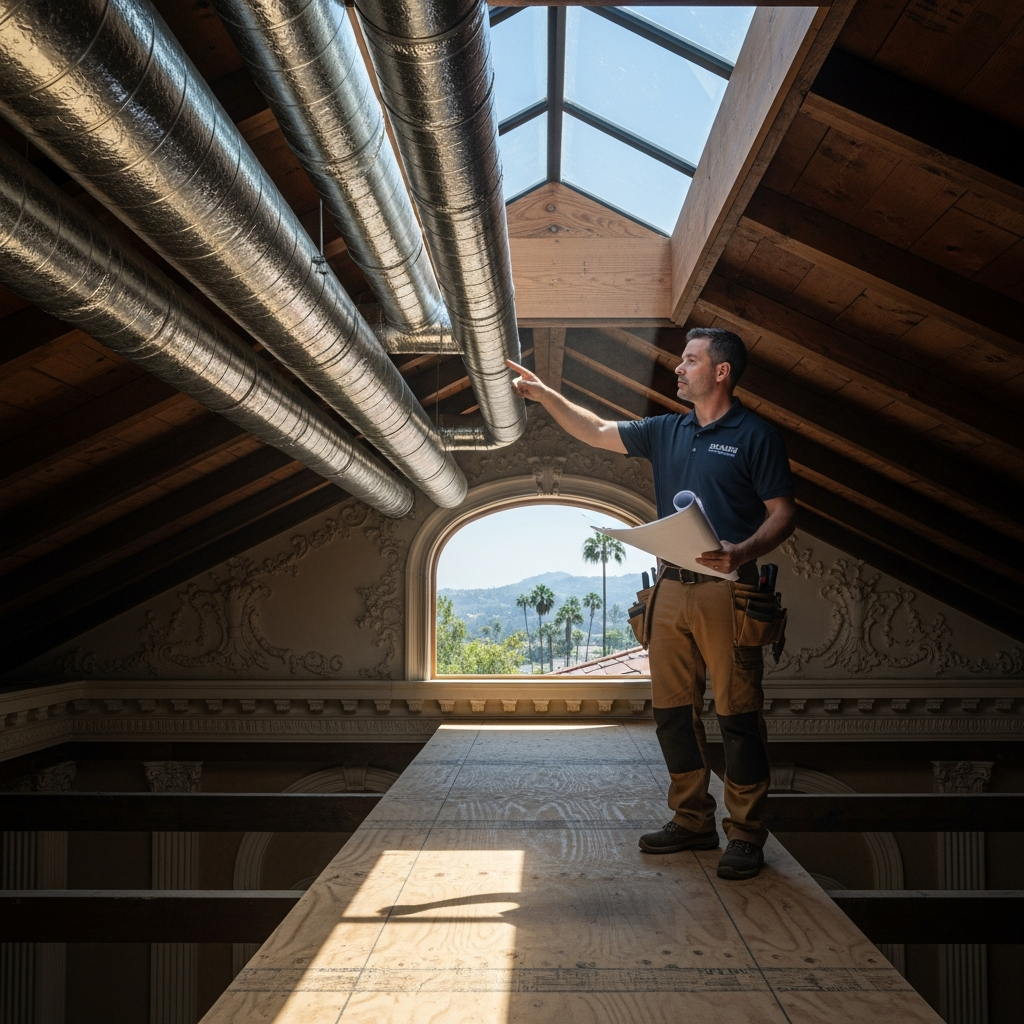
Architectural character is part of Beverly Hills’ identity, and duct replacement must respect it. Plaster ceilings, ornate crown mouldings, and custom millwork are not obstacles—they are heirlooms to be protected. That translates into methodical planning so that registers are placed with purpose, grilles complement aesthetics, and any necessary access points are discreet and fully repaired. In hillside properties with sweeping views, the mechanical rooms and pathways are often stacked in challenging vertical arrangements. Moving large duct sections safely and accurately through tight staircases or narrow exterior pathways can extend timelines. The work pace slows not from inefficiency but from the level of care needed to protect finishes and preserve the home’s character.
Historical elements sometimes introduce specialty considerations. Older insulation types or abandoned materials must be handled correctly, and when there is any suspicion of hazardous materials in old duct systems or surrounding structures, licensed environmental professionals should be consulted before work proceeds. That diligence protects homeowners, workers, and the long-term value of the property. Although such precautions are not always necessary, when they are, they shape scheduling and coordination.
Materials and Craftsmanship
There is no one-size-fits-all material for ducts in our area. Sheet metal offers durability, precise sizing, and excellent interior smoothness when fabricated correctly. Flexible ducts provide versatility for navigating obstructions, but they must be supported and routed meticulously to avoid kinks and compression. Duct board can deliver excellent acoustical performance in certain applications when expertly sealed and finished. The right solution is often a blend: rigid trunks for stable airflow, carefully sized takeoffs for balance, and short, properly supported flex runs for final connections. The quality of transitions, the alignment at fittings, and the attention to sealing compound application determine real-world results more than the material label itself.
Insulation is equally important. Continuous R-values appropriate for our climate help stabilize supply temperatures and prevent unwanted heat exchange in attics exposed to summer sun or cool evening breezes. More than thickness, the continuity of the insulation—free of gaps, compression, and voids—protects performance. Craftsmanship means clean seams, smooth bends, and supports placed to preserve roundness and internal area, ensuring the blower encounters as little resistance as possible.
Design, Sizing, and Performance Targets
Many Beverly Hills homes have experienced decades of piecemeal modifications: add a bath here, convert a sunroom there, and suddenly the original duct system no longer matches the current living pattern. Heat gains on west-facing glass in Trousdale or cool airflow requirements in shaded canyon rooms differ widely. A modern replacement should start with thoughtful calculations and a room-by-room review. The objective is not just to push air but to deliver the right volume to each space at the right velocity and temperature.
Right-sizing is about comfort and acoustics as much as efficiency. Oversized ducts can slow air excessively, leading to poor mixing, while undersized ducts hiss and still fail to deliver enough air. Strategic zoning may be warranted in multi-story or sprawling floor plans so that bedrooms, entertaining areas, and workspaces each receive the attention they need. This is a design conversation as much as a construction one, and it directly shapes the equipment’s workload and the environment you experience daily.
Access, Logistics, and Neighborhood Nuance
From Beverly Hills Flats to Benedict Canyon, each neighborhood has its own logistical realities. Narrow streets, limited on-site parking, and local rules about work hours shape how crews stage materials and schedule phases. Protecting driveways and pathways, safeguarding landscaped courtyards, and coordinating with interior designers or property managers add layers of planning. These logistical steps may be invisible in the finished product, but they ensure the process runs smoothly and respectfully.
Inside the home, access matters more than most people realize. Working above plaster, maneuvering around recessed lighting, or threading ducts through tight soffits without compromising structure requires specialized techniques and often custom fabrication. Crawl spaces may be shallow or segmented, which affects whether ducts are best routed above or below, whether chases should be created, and how condensation risks will be managed around cooling lines. These choices define the day-to-day scope and, by extension, the overall investment.
Permits, Code, and Verification
California’s performance standards prioritize sealing integrity and energy-smart design. In practice, that means replacement projects typically include testing to document leakage levels and confirm that systems are performing as designed. It is not enough to “feel” that airflow is better; a well-documented project demonstrates it. For Beverly Hills homeowners, this assurance aligns with the city’s reputation for excellence. A thorough approach includes pressure testing, temperature split verification, and balancing adjustments to align each room with its target supply volume. These steps transform the conversation from speculation to measurable outcomes.
Documentation also preserves value. When you eventually remodel, sell, or expand, you will have a clear record of what was done, how it was tested, and why the system performs as it does. That transparency is increasingly appreciated by buyers and their advisors, who can quickly grasp that the duct system was handled by professionals with a clear process and deliverables.
Indoor Air Quality Priorities
Comfort in Beverly Hills is not just about temperature—it is also about breathing clean, pleasant air. A thoughtful duct replacement can support this goal by improving how filters are located and accessed, how returns are sized, and how infiltration from attics or crawl spaces is limited. Better-sealed ducts prevent dusty, unconditioned air from being pulled into the system, and well-placed returns reduce pressure imbalances that might otherwise draw in outdoor air through gaps in the envelope. For clients sensitive to seasonal pollen or during wildfire smoke events, sealing details and filtration strategies become essential conversations during design.
Placement of returns is one of the most overlooked elements affecting air quality and noise. Inadequate or poorly positioned returns force higher velocities that can whistle or buzz, and they may compromise filtration effectiveness. Upgrading the return path during replacement, even if it requires thoughtful carpentry or redesigned grilles, often provides outsized improvements in how the home feels and sounds.
Noise and Comfort Details
Quiet is a hallmark of luxury. Excessive velocity at registers, poorly designed transitions, and resonance in thin or poorly supported duct sections all add unwanted sound. During a replacement project, opportunities arise to refine diffuser selection, adjust throw patterns, and add acoustical lining or strategic flex sections that dampen vibration. These are the details that allow a home theater to remain whisper-quiet during a summer matinee or a primary suite to feel serene during overnight cooling.
Even temperatures throughout the home depend on balanced supply to every room and a return path that allows air to flow back without doors needing to be left ajar. During replacement, installing jumper ducts or transfer grilles, when appropriate, can eliminate the pressure differences that cause doors to thump closed or rooms to feel stuffy. The end product is not just new materials—it is a more refined experience of comfort.
The Midpoint Decisions That Shape Outcomes
In the thick of project planning, homeowners and contractors make decisions that ripple through outcomes for years. Whether to relocate a main trunk, how to handle a problematic soffit, or how to stage work to minimize disruption are all midpoint choices that separate satisfactory projects from exceptional ones. It is during this phase that clear communication pays off, ensuring that the design intent is carried faithfully into installation, and that everyone is aligned on priority spaces and finish protection. For guidance and clarity during this pivotal stage, many residents reference trusted local insights on duct replacement services to confirm they are on the best path.
Process From Consultation to Verification
A strong process begins with a walkthrough focused on comfort complaints and architectural realities. From there, documentation of existing duct sizes, paths, and conditions sets the stage for informed design. Demolition is approached with protection in mind—covering floors, isolating work zones, and maintaining air quality in occupied areas. Installation advances methodically, beginning with trunks and branches, then moving to takeoffs, supports, and insulation. Along the way, quality checks confirm that seams are sealed, supports are spaced properly, and airflow pathways remain smooth and true to design.
Commissioning brings the system to life. Testing for leakage, verifying airflow to each room, and adjusting balancing dampers ensure the results match expectations. This is when the precision built into design and installation becomes tangible: quieter operation, even temperatures, and a house that simply “feels right.” Homeowners often remark that rooms they had avoided because of drafts or uneven temperatures suddenly become favorites.
Timelines and What to Expect
While every property is different, most homeowners appreciate a clear schedule with milestones. You can expect an initial assessment and design period, followed by material procurement, staging, and a carefully sequenced installation. Access point repairs, paint touch-ups, and grille upgrades complete the visual finish, while performance testing confirms the invisible improvements. Communication throughout—especially around any unexpected discoveries—keeps the project predictable and respectful of daily routines.
Maintaining cleanliness during work is as important as the technical execution. Temporary filtration at the equipment, containment where dust might be disturbed, and end-of-day tidying all contribute to a process that feels as professional as the outcome. When the last register is balanced and the final report is shared, you should feel not only the difference in comfort but also the confidence that the system is set up for years of reliable service.
Long-Term Value and Avoided Headaches
Replacing ducts is an investment in how your home performs every hour of every day. Better-designed ducts reduce strain on equipment, which supports longevity and reliability. They also create a foundation for future upgrades, whether that means adding zoning, integrating better filtration, or switching to equipment that excels in our climate. The point is not to chase short-term fixes but to align the hidden infrastructure of your home with the way you live, entertain, and relax.
In our area, where homes are expressions of personal taste and history, a quiet, invisible system that simply works becomes part of the luxury. The avoided headaches—stuffy corners, whistling registers, rooms that refuse to cooperate—quickly fade into memory. In their place is a home that meets you with consistent comfort from the moment you walk through the door.
Frequently Asked Questions
How do I know my ducts are the real issue and not the equipment?
Uneven temperatures, persistent dust, doors that thump closed when the system runs, and rooms that never quite feel right often point to airflow problems. A thorough assessment that measures static pressure, checks register temperatures, and evaluates duct sizing will isolate whether the ducts or the equipment are to blame. Many Beverly Hills homes have excellent equipment hamstrung by undersized or leaky ducts—solving the distribution unlocks the comfort the system was capable of all along.
Will duct replacement make my home quieter?
Yes, when designed carefully. Properly sized trunks and branches allow lower air velocity, which reduces hiss. Thoughtful transitions and supports reduce vibration, and choosing the right diffusers for each room prevents turbulence that can create whistle at the grille. Quiet is rarely a happy accident; it is the result of deliberate design choices implemented with care.
Can I keep some existing ducts and replace only the worst sections?
Sometimes strategic partial replacement makes sense, particularly if sections are already well-routed and in good condition. However, mixing new and old can lock in existing design flaws. The decision should be guided by measurements, visual inspection, and design requirements for each room. If a partial approach compromises airflow targets or sealing integrity, it may be wiser to complete a comprehensive replacement.
What about permits and inspections?
Permitting helps ensure the work aligns with safety and performance standards. In Beverly Hills, documentation and inspections provide peace of mind not only for you now but also for any future buyer. Verification testing validates that ducts are sealed and balanced as intended. A professional team will coordinate permits, inspections, and test reports so you have a complete record.
How long does a typical project take?
Duration varies with home size, access, and design complexity. A focused plan and skilled crew can maintain momentum while protecting finishes and daily routines. The most time-intensive projects tend to involve architectural preservation, complex logistics, or significant design rework, all of which are worthwhile when they produce a quiet, comfortable, and efficient result.
Will new ducts improve indoor air quality?
Better-sealed ducts reduce the chance of drawing dust from attics or crawl spaces, and right-sized returns help filters do their job effectively. If filtration upgrades are part of the design, access for maintenance becomes easier, which keeps performance consistent. Many homeowners notice reduced dust settling and a fresher feel within days of completion.
Do I need to be home during the work?
It helps to be available during key milestones—initial walkthroughs, design discussions, and final verification—but you do not need to be present every hour. Clear communication about access, protection, and daily goals allows work to proceed smoothly whether you are on-site or not.
What happens if we discover a surprise inside the walls or attic?
Discoveries are part of working in unique homes. The right team will communicate quickly, provide options, and explain the implications for design and schedule. Most surprises are solvable with creativity and proper planning, and addressing them now prevents bigger issues later.
Ready to quiet the noise, even out room temperatures, and breathe easier?
If you are weighing your options and want guidance tailored to your home, connect with a trusted local team that treats craftsmanship as nonnegotiable. From careful design to verified results, your project should honor the architecture you love while elevating the comfort you live with every day. Begin the conversation today by exploring Beverly Hills duct replacement insights, and let your home’s hidden system become one of its most satisfying features.