
The Beverly Hills Backdrop: Climate and Construction
When we talk about duct replacement in Beverly Hills, we are talking about systems that must serve homes exposed to salt air, shifting temperatures, and the occasional punishing Santa Ana wind. The construction types are equally varied: beach bungalows with low crawlspaces, hillside homes with twisting attics, and modern builds with expanses of glass facing the Pacific. That variety means the same duct problem can show up differently from house to house. Understanding those patterns—and how to avoid them during replacement—helps ensure a smoother project and an outcome that actually feels better day to day. Thoughtful duct replacement is less about swapping parts and more about aligning design with the realities of the site and the way the family lives.
Older systems in Beverly Hills often grew organically. A room addition here, a reconfigured kitchen there, a remodel that moved walls without rethinking airflow—the net result can be a patchwork of duct sizes, abrupt transitions, and mismatched returns. When you replace, you inherit the chance to clear the slate, but only if you catch the common pitfalls before they sneak into the new design.
Issue 1: Undersized Returns and Starved Airflow
Nothing undercuts comfort faster than a system that cannot breathe. A single, undersized return trying to serve a large open-plan living area creates high velocity, noise, and uneven temperatures. You hear it as a rush at the return grille and feel it as weak supply air in distant rooms. The fix is rarely complicated: add or enlarge returns, route them to quieter locations, and line the return paths to reduce noise. During replacement, make return sizing a nonnegotiable priority, and remember that a serene home is the byproduct of generous, balanced airflow, not just strong supply pressure.
In two-story canyon homes, the temptation is to place a return near a stairwell and call it a day. But rising warm air can trick the system into cycling based on stairwell conditions while bedrooms remain uncomfortable. Splitting returns by zone or adding a dedicated bedroom return often solves problems that no amount of supply tweaking can address.
Issue 2: Leaky Connections and Insufficient Sealing
It is easy to underestimate how much energy disappears through small leaks. Attics are especially guilty: a few unsealed boots, a wobbly takeoff, or aging tape can send conditioned air into the insulation rather than the room. Over years, those leaks add up to noisy operation and sticky summer afternoons indoors. The replacement solution is comprehensive sealing—mastic on joints, UL-rated tapes where appropriate, and boots properly fastened to framing. The goal is not perfection for its own sake; it is ensuring that the air you pay to condition reaches the space you live in.
Salt air accelerates deterioration. Metal that might last longer inland can show corrosion near vented eaves by the coast. Inspect and replace rusted components rather than reusing them, and consider corrosion-resistant hardware. It is a small cost in materials that makes a large difference in longevity.
Issue 3: Poor Routing and Pinched Runs
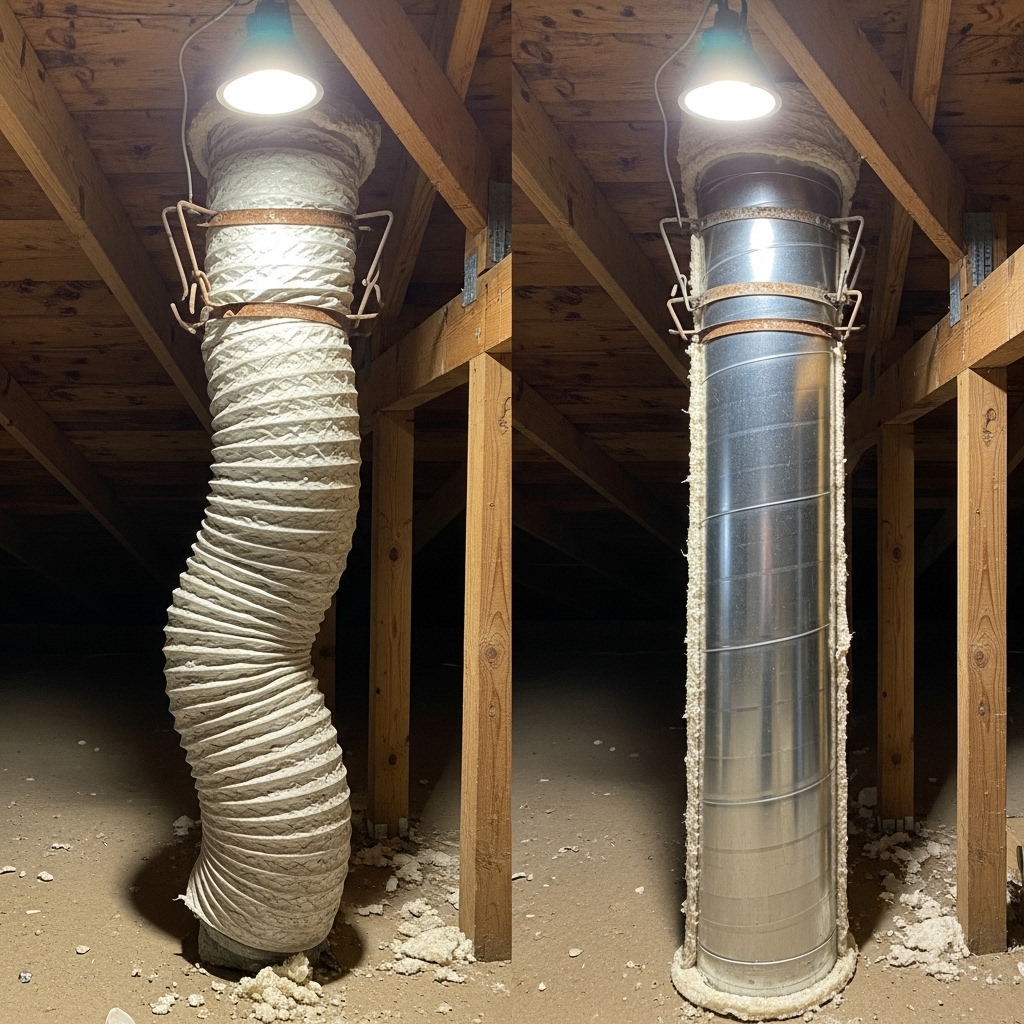
In tight attics and crawlspaces, it is tempting to snake flex duct around obstacles with tight bends and long unsupported spans. Those choices create friction losses and sagging that strangles airflow. During replacement, map routes with smooth, sweeping bends, support flex runs at proper intervals, and use rigid sections and long-radius elbows where turns are unavoidable. Every change of direction is a chance to lose energy and gain noise; designing for graceful transitions pays back with quieter, more even delivery.
Hillside framing can introduce surprising pinch points. Older rafter bays, bracing, and utility runs leave narrow pathways. A careful survey before demo reduces improvisation. When we know the tight spots, we can spec slimmer, insulated rigid sections or adjust register locations so the system serves the room without torturing the duct.
Issue 4: Mismatched Sizing and Legacy Equipment Assumptions
Many Beverly Hills homes still carry ductwork sized for equipment that no longer exists. Perhaps a furnace was upgraded or a heat pump was installed without revisiting the duct design. Oversized supply trunks can lead to low velocities that don’t throw air far enough; undersized branches can choke delivery to a remote bedroom. Replacement is the moment to perform a proper load calculation and design for the actual home, not the home as it was decades ago. It is not glamorous, but it is the difference between a system that finally feels right and one that repeats old frustrations.
Open-plan renovations add a twist. Removing walls changes airflow patterns and increases the volume a single supply must serve. A design that once worked for compartmentalized rooms falls short. Adding a supply or relocating a register is often a simple, high-impact fix when paired with correct duct sizing.
Issue 5: Condensation, Insulation Gaps, and Coastal Moisture
Cool air moving through warm spaces, or warm air through cool ones, can create condensation where insulation is inadequate or compromised. On the coast, humidity and salt amplify the problem, encouraging rust and musty odors. Replacement is the opportunity to upgrade insulation values, ensure continuous vapor barriers, and eliminate compressions that reduce R-value. Pay special attention to boots at the ceiling plane; a poorly insulated boot can become a cold spot that collects moisture and dirt, leading to those familiar dark rings around grilles.
In crawlspaces, it is common to find ducts resting on soil or pressed against joists in ways that flatten insulation. Proper hangers and clearances protect both performance and durability. The goal is to treat the duct like a long-term building component, not a temporary hose to be squeezed wherever it fits.
Issue 6: Noise From High Velocity and Turbulence
Noise is often the symptom homeowners complain about first. Whistling registers, rumbling returns, and thumps on startup signal turbulence and pressure issues. The cures are mechanical empathy and gentle transitions: upsize returns, choose diffusers that spread air without shriek, add acoustic lining where appropriate, and avoid sudden area changes. When replacement is done well, the system fades into the background, and the house reclaims its sonic calm—the ocean, conversation, and quiet music instead of mechanical chatter.
It is worth noting that a perfectly silent system is neither realistic nor necessary. The aim is a soft, even presence—air that arrives without calling attention to itself. Designing toward that aim informs every choice, from elbow radius to grille selection.
Issue 7: Access and Serviceability Over the Long Term
Replacement is also your chance to think like a future technician. Will filters be easy to change without a ladder ballet? Are control dampers reachable without removing half the attic? Can a homeowner visually inspect key connections without crawling through insulation? Simple decisions, like adding a short access panel or locating a return where it can be opened without moving furniture, make maintenance frictionless. Those conveniences keep the system performing as designed rather than drifting as filters go unchanged or small issues go unseen.
In Beverly Hills’s salty, sometimes smoky environment, serviceability supports resilience. When smoke blows in, you want to swap filters fast. When a windstorm rattles a vent cap, you want to take a quick look without a production. Replacement that bakes in ease of access pays for itself the first time you need it.
Issue 8: Incomplete Commissioning and Testing
Even beautifully installed ducts can underwhelm if the system is not commissioned. During replacement, insist on airflow measurements, static pressure checks, and balancing at registers. This is where theory meets reality. A small damper adjustment can rescue a quiet corner; a return grille swap can unlock a smooth hum instead of a hollow roar. Commissioning is not an add-on; it is the final step that ensures the home feels the way the drawings promised.
We also verify that thermostats read reality. Sun-struck walls and drafts can lie to sensors, causing short cycling or overshoot. Pairing duct replacement with smart thermostat placement or remote sensors turns a good install into a great one.
Mid-Project Choices: Where Problems Disappear
Most missteps are avoidable if you make careful decisions as surprises arise. Perhaps a planned route hits an unexpected beam; maybe a register placement proves less effective than imagined when you mock it up on site. Staying flexible allows the project to adapt gracefully. A quick test with the blower on can reveal whether a new return is whisper-quiet or too present in a living space. Right in this middle stretch is the perfect time to confirm that the scope still aligns with goals—quieter bedrooms, better throw to a reading nook, or stability in a glassy great room. It’s also a good checkpoint for homeowners who are considering complete duct replacement to trust the plan and greenlight any smart refinements.
Communication is the thread that keeps quality high. Homeowners know how rooms feel through the day; installers know how ducts behave under pressure. Put those perspectives together in the middle of the project, and you catch issues while they are cheap to fix.
The Payoff: A Home That Behaves
When common issues are addressed head-on, the results are cumulative. The house warms and cools evenly. Doors don’t slam from pressure imbalances. The system starts softly, runs quietly, and stops without drama. Dust settles less aggressively, and coastal humidity doesn’t intrude on the indoor experience. You notice the difference most when you stop noticing the system at all—comfort becomes the default rather than a negotiation.
That sense of resolution matters in Beverly Hills, where a home should frame the ocean and canyon breezes rather than fight them. With a solid replacement, the invisible infrastructure supports the visible beauty, and daily life takes on an ease that is hard to quantify but easy to appreciate.
Frequently Asked Questions
Q: What’s the most common mistake during duct replacement? A: Undersizing returns and skipping thorough sealing. Both lead to noise, inefficiency, and uneven rooms that persist after the project.
Q: My ducts look fine in the attic. Could problems still exist? A: Absolutely. Hidden leaks at boots, poor register choices, and sizing mismatches don’t always show visually. Testing and commissioning reveal what eyes miss.
Q: Are flex ducts bad? A: Not inherently. Flex used appropriately, with gentle bends and proper support, performs well. Problems arise when flex is overused or allowed to sag and kink.
Q: How do Beverly Hills’s coastal conditions affect materials? A: Salt air accelerates corrosion. Selecting corrosion-resistant fittings and ensuring continuous insulation and vapor barriers extend system life near the ocean.
Q: Will replacement reduce wildfire smoke infiltration? A: Yes. Tighter ducts and proper return design reduce unfiltered air intrusion from attics and crawlspaces, improving indoor air quality during smoke events.
Q: How can I keep the new system quiet? A: Prioritize return sizing, smooth transitions, and commissioning. Small choices—like diffuser type and elbow radius—add up to big noise reductions.
Move Forward With Confidence
If you are navigating decisions about your home’s air pathways, focus on the common pitfalls and address them with design, materials, and testing. The result is a home that finally behaves in every season. When you are ready to talk specifics for your property, start with a conversation centered on duct replacement that respects Beverly Hills’s climate, your architecture, and the way you live.