
Understanding What Shapes the Average Air Duct Cleaning Cost in Beverly Hills
Ask ten Beverly Hills homeowners what they think goes into the average price of cleaning their ductwork and you will likely hear ten very different answers. Some will point to home size, others will cite the number of supply and return vents, and still others will bring up how long it has been since their last service. In truth, all of these play a role, and the context of our community makes each factor more pronounced. From hillside estates with complex architecture to discreet service schedules that respect privacy and security, local expectations and building styles mean estimates are built on many moving parts. Early in the process, it helps to frame the conversation around scope, access, and cleanliness goals rather than a single number, and to look at air duct cleaning as a tailored service rather than a commodity.
In Beverly Hills, the definition of an “average” home doesn’t really exist. Condominiums along tree-lined streets coexist with historic villas and modern glass pavilions tucked into the canyons. Each layout changes how crews reach supply trunks, returns, and branch lines. Tall ceilings, decorative soffits, and custom registers introduce aesthetic considerations that require extra care, and older residences may include plaster or specialty finishes that are less forgiving during access. When a professional evaluates a property here, the initial walkthrough is about much more than counting vents; it is a study in building anatomy and how to work within it without leaving a trace.
Home Size, Zoning, and System Complexity
Square footage is relevant, but the number of HVAC zones and the way those zones are distributed typically matters more. A 4,000-square-foot home with one straightforward system can be simpler than a smaller residence split across multiple air handlers serving guest wings, subterranean levels, and pavilions. Dual returns in great rooms, dedicated filtration for wine cellars or galleries, and sophisticated zoning dampers multiply the touchpoints. Each additional air handler brings its own plenum, blower cabinet, and coils to protect during cleaning, and the duct paths that feed those systems may be routed through difficult spaces such as crawl areas, mechanical chases, or concealed bulkheads. Complexity increases planning, setup, and post-clean verification because all components need to be left pristine and functionally sound.
Within luxury homes, the materials used for ductwork add their own nuances. Rigid sheet-metal ducts respond differently to agitation and vacuum methods than insulated flex lines or lined plenums. Professionals select tools that respect those materials, balancing thorough debris removal with the need to preserve internal insulation and ensure no fibers are released. When sound attenuation or architectural acoustics are part of a media room or studio, the approach is even more precise, with containment and gentle methods prioritized to avoid disturbance while still improving air quality.
Access and Preservation of Finishes
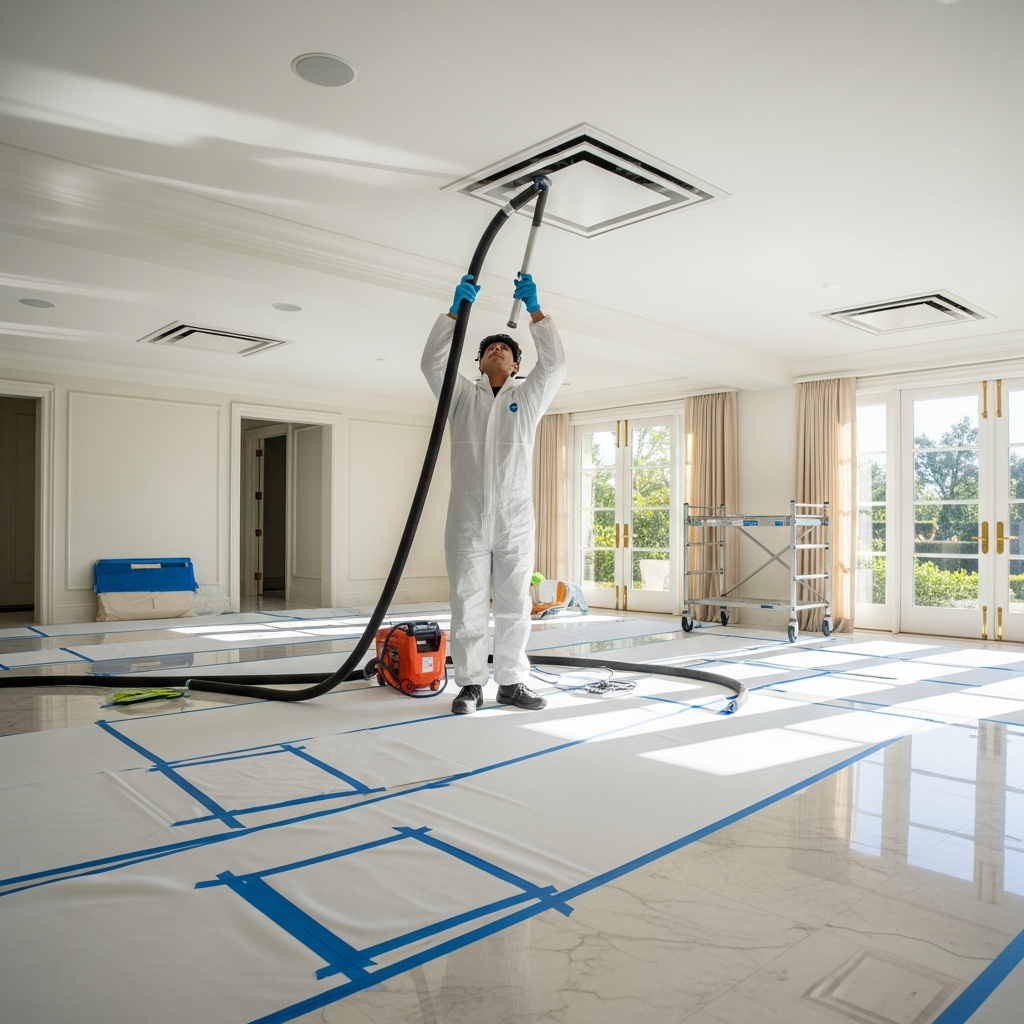
Access is one of the most influential drivers that people often underestimate. In a Beverly Hills residence with polished stone floors, hand-painted wall treatments, or custom millwork, every step—from laying down protective runners to taping registers—requires white-glove care. Where mechanical rooms are compact or tucked behind hidden panels, crews must stage equipment creatively, sometimes running longer vacuum lines or using portable negative-air machines designed for tight spaces. If returns sit high above architectural features, safe reach solutions may include specialized ladders or scaffold towers sized for interiors, and time spent setting up this access is time well invested to keep the home immaculate. The more delicate the finishes, the more methodical the containment, and the more detailed the cleanup, all of which shape the average project footprint.
In multifamily buildings and luxury condos, access coordination extends to elevators, loading docks, and HOA rules about work hours and noise. Scheduling windows, insurance certificates, and building engineer check-ins become part of the planning. If negative-air equipment cannot be staged outdoors, noise mitigation and careful routing of hoses through common areas become additional considerations. While these steps do not alter the goal—a clean, efficient duct system—they do influence the resources required to deliver that result without disrupting neighbors or building operations.
Condition of the Ducts and Level of Contamination
The baseline condition of the ductwork is another major factor. Homes hosting frequent gatherings, households with pets, or residences that have recently completed interior renovations can exhibit more dust, dander, and fine particulates than properties with lighter usage. In canyons and foothill neighborhoods, winds can drive outdoor particulates that settle in returns; after wildfire seasons, soot and odor molecules may complicate the cleaning strategy. When accumulations are heavier or cling more stubbornly, technicians adjust agitation techniques, spend more time sealing and unsealing registers, and increase passes with HEPA vacuum equipment. If microbial concerns are present due to moisture issues, the scope may incorporate targeted remediation practices once a cause has been identified and addressed, always with the intent to protect indoor air without introducing harsh residues.
Not all dirt looks the same under the registers either. Fine plaster dust behaves differently than accumulated textile fibers from carpeting and upholstery. Kitchens and catering spaces can send aerosols through returns that adhere to duct interiors in sticky films requiring more deliberate agitation. A thorough contractor will identify what they are seeing and select solutions that remove the contaminant rather than simply pushing it along. This assessment stage informs the game plan and is a core piece of why “average” is only a starting point, not a promise of identical results from one residence to the next.
Scope Boundaries: What’s Included, What’s Adjacent
Another driver of the final workload is how the scope is framed. True duct cleaning involves the supply lines, return lines, and air handling components where dust commonly accumulates. Adjacent tasks—such as dryer vent cleaning, coil cleaning, or sealing around leaky boots—may be recommended as complementary work when inspections uncover issues that could undermine the results of a duct service. Sometimes homeowners choose to stagger these tasks; other times they prefer a single mobilization to address multiple concerns. Clarifying where the line is drawn keeps expectations aligned and helps homeowners compare proposals on equal terms, particularly when different providers describe their inclusions in different ways.
Documentation matters as well. Before-and-after photos taken at registers, inside trunk lines, and at the blower cabinet provide a transparent record of the work. Video snaking in long trunk sections can reveal turns and transitions that benefit from targeted attention. The more precise the documentation, the easier it is to demonstrate improvement and to make a plan for future maintenance intervals that reflect how the home is actually used rather than a generic calendar recommendation.
Timing, Crew Size, and Logistics
Project timing intertwines with logistics and crew size. Some Beverly Hills owners prefer service early in the day before staff arrive; others need evening hours to avoid interfering with remote work or rehearsals in home studios. Coordinating with household staff or property managers to protect pets, secure art, and silence sensitive alarms adds planning steps that experienced teams handle smoothly. Larger crews can shorten on-site time, but they also require more staging space and tighter choreography to keep the home orderly. Conversely, a smaller two-person team may be ideal for condos with limited access, even if the total time on site is longer. Matching crew configuration to each property ensures a calmer experience and elevates results.
Seasonality plays a role in both demand and the nature of what is being removed. During dry, windy periods, particulate loads may spike, and after storms, moisture intrusion around roof penetrations or crawl spaces can increase humidity in returns. This is why many local homeowners schedule routine maintenance on a rhythm that aligns with their actual patterns of use—often after heavy entertaining seasons or following interior projects—rather than a fixed month on the calendar.
Luxury-Level Considerations Unique to Beverly Hills
Discretion, protection of finishes, and respect for privacy are not add-ons in Beverly Hills; they are foundational expectations. Technicians trained for high-end environments understand that containment is about more than dust. Quiet equipment selection, inconspicuous routing of hoses, and careful staging protect the soundscape and the look of the property during service. Where guests or clients are present, technicians coordinate movement through the home with the same professionalism expected from other luxury vendors, and nondisclosure and security protocols are embraced as standard practice. When a home includes sensitive areas—screening rooms with specialized acoustic treatments, gallery spaces, or climate-controlled storage—the cleaning plan prioritizes those conditions so that the environment is preserved while air pathways are refreshed.
Even in historically significant homes, the aim is to intervene gently. Access plates, if needed, are cut in discreet locations and refinished to blend back seamlessly. Register hardware is handled with gloved hands, and soft protection blankets are used at contact points. These techniques take time and finesse, both of which influence how the “average” project unfolds here compared with other markets.
Planning, Comparing, and Choosing Value Over Velocity
Because Beverly Hills homes are so individual, the most useful comparison point is not how quickly a provider can be in and out, but how completely they address the specific needs of the property. A thoughtful proposal will reference what was observed during inspection, identify the systems and zones, outline protection and containment measures, and explain how success will be verified at the end. During conversations, ask how they protect coils, whether they use HEPA-filtered negative-air, and how they ensure all registers are reinstalled with perfect alignment. These discussions are less about chasing the lowest estimate and more about safeguarding the home while meaningfully improving indoor air.
Midway through planning, it often helps to revisit the original goal—cleaner, healthier circulation—so that the scope supports that objective. If the home hosts frequent events, consider how traffic patterns and wardrobe storage might affect returns. If pets are part of the family, be sure technicians plan gentle containment solutions that keep animals secure but comfortable. Re-centering decisions on outcomes keeps the project from devolving into a race between incomparable proposals and reminds everyone that air duct cleaning is a means to a healthier, calmer home rather than a box to check.
Day-of Expectations and Post-Clean Confidence
On service day, homeowners can expect a rhythm that starts with protection and staging. Floor and wall coverings go down, registers are carefully removed, and vents are sealed to maintain negative pressure while sections are cleaned sequentially. Agitation tools gently lift debris while powerful vacuums capture and contain it. The air handler and blower components are shielded to avoid dislodging dust into living spaces. When everything has been addressed, registers are reinstalled and aligned, containment is removed, and a final walkthrough confirms that surfaces and furnishings look untouched—except for air that now feels fresher and circulation that sounds smoother.
After the service, documentation provides reassurance. Photos and notes, sometimes supplemented by short videos, show what was found and what was removed. If the technician identified leaky boots, gaps at registers, or insulation disturbances in attic runs, those items will be discussed with options for improvement. A clear maintenance recommendation follows, not as a one-size-fits-all interval, but as a reflection of the home’s lifestyle rhythms. Owners often notice that regular dusting holds a bit longer and that the HVAC filter loads more predictably, helping them plan filter changes with confidence.
Common Misconceptions and How to Think Beyond Them
A frequent misconception is that the number of vents is the sole determinant of effort. In reality, some vents are simply gateways to longer, more complex runs with multiple turns and transitions, while others connect to short, straight paths. Similarly, two returns of identical size may serve very different zones with different contamination loads. Another myth is that a spotless home will have spotless ducts. Even in immaculately maintained residences, invisible particulates travel through returns and settle in low-turbulence areas of ductwork, and those accumulations benefit from periodic removal. Thinking in terms of airflow patterns, materials, and usage paints a truer picture of what a thorough job entails.
There is also the idea that cleaning ducts will solve every indoor comfort issue. It is a powerful contributor, particularly for sensitive occupants, but draftiness, room-to-room temperature swings, and persistent odors can also be tied to insulation gaps, window seals, or even imbalances in supply and return. A seasoned provider will call out when supplementary steps—balancing, sealing, or filtration upgrades—could meaningfully improve comfort so owners can decide what fits their priorities.
When Maintenance Cleaning Becomes Restorative Work
Most homes benefit from periodic maintenance that keeps buildup in check. Occasionally, a property will present with conditions that call for restorative efforts: post-renovation dust infiltrating every branch, evidence of past moisture that left musty notes in long trunk lines, or soot fractions after a regional event. In those cases, the plan may involve more thorough agitation, extended negative-air capture, or focused treatment of affected sections once the underlying moisture source has been addressed. What distinguishes restorative work is the careful calibration between sufficient force to remove stubborn contaminants and gentle technique that preserves duct integrity and interior finishes. With the right team, even challenging projects can be completed in a way that leaves the home feeling renewed rather than disrupted.
Setting Expectations for a Beverly Hills Standard
At the end of the day, the average Beverly Hills project is shaped less by a generic template and more by a shared commitment to craftsmanship and care. From luxury estates to refined condos, the standard here includes immaculate protection, professional restraint, and open communication. A well-executed cleaning respects the home’s design language, leaves mechanicals operating smoothly, and supports a healthier interior environment. When you frame the conversation around the right questions and align the scope to the unique conditions of your property, the “average” gives way to something more personal: a result that feels right for the space you live in.
FAQ: Beverly Hills Homeowners’ Most Common Questions
How often should ducts be cleaned in Beverly Hills? Frequency depends on how you use the home. Residences with pets, frequent entertaining, or recent renovations may need more regular attention than quieter homes. Local conditions such as seasonal winds or regional smoke can also influence timing. A tailored interval based on your patterns—confirmed by filter loading and visual checks—works far better than a generic calendar date.
Will cleaning the ducts help with odors? It can, especially when odors are tied to dust accumulations in returns or residues in branch lines. However, odors sometimes originate from moisture intrusion, drain lines, or materials outside the duct system. A proper inspection will help pinpoint sources so that cleaning targets the root causes instead of masking symptoms.
What does a professional do to protect finishes? Experienced teams stage with soft coverings, create containment around work areas, use HEPA-filtered negative-air equipment, and handle registers with care. They also coordinate access to minimize disturbance, and they document the condition of contact points so everything is returned exactly as found.
Do I need to leave the house during service? Most homeowners stay on site, but many choose to step out for parts of the day, especially during agitation. With proper containment and equipment, noise is modest and dust is captured rather than released. If you have sensitivities, your provider can adjust scheduling and sequencing to keep you comfortable.
What’s the difference between supply and return ducts? Supply ducts deliver conditioned air to rooms, while returns pull air back to the system to be filtered and reconditioned. Returns often collect more fine dust because they are the gateways drawing air from living spaces; both sides deserve attention for optimal cleanliness and performance.
How do I know the job was done thoroughly? Ask for photo documentation from multiple locations in the system, not just one or two registers. Clear before-and-after images, along with notes about what methods were used and where, provide a transparent record. You may also notice steadier filter performance and subtler backgrounds sounds from airflow once debris is removed.
Can duct cleaning improve allergies? For many residents, removing built-up dust and dander can noticeably reduce triggers in the indoor environment. While it is not a medical treatment, cleaner ducts are a meaningful component of a broader strategy that may include upgraded filtration, humidity control, and regular housekeeping routines.
What makes Beverly Hills projects different? The combination of architectural variety, fine finishes, privacy expectations, and complex mechanical zoning raises the bar. Teams serving this market bring specialized protection, documentation, and discretion so the home looks untouched while the air pathways are renewed.
Talk with a Local Expert
If you are ready to plan a thoughtful, property-specific approach that respects your home and delivers meaningful results, reach out to a trusted local team. A brief conversation and a careful walkthrough will clarify the right path forward, set expectations, and help you prioritize the work that matters most. To begin on your schedule and on your terms, explore professional air duct cleaning options tailored to Beverly Hills and feel the difference of a home that breathes as beautifully as it looks.