
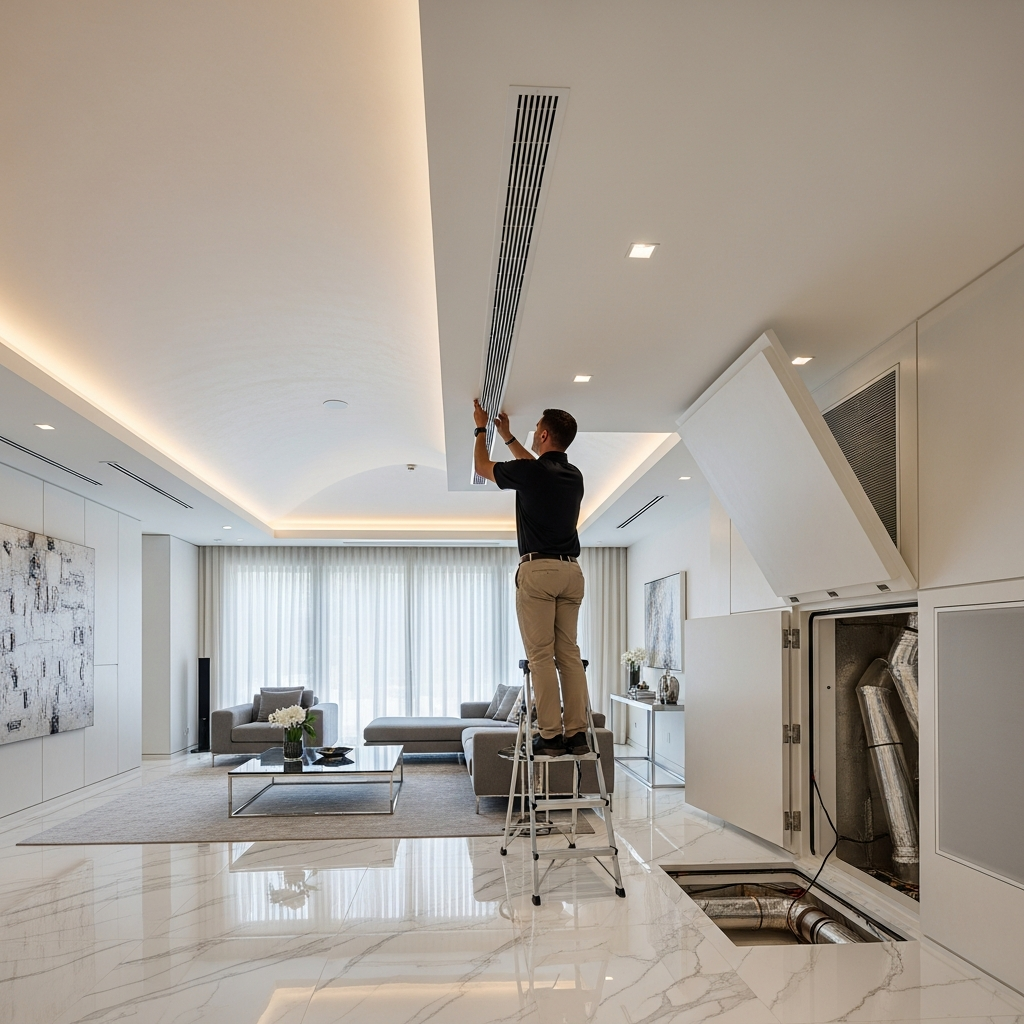
In Beverly Hills, luxury homes are more than square footage and finishes; they are curated environments where light, texture, and quiet comfort work together. HVAC duct replacement in these properties is a bespoke craft, shaped by architecture, lifestyle, and the expectation that the home feels as refined acoustically as it looks visually. When clients ask what distinguishes high-end ductwork, I point to three pillars: design that respects the architecture, materials and methods that protect finishes and deliver whisper-level performance, and a process that fits into life with discretion. If you are considering updates, an informed look at duct replacement through a luxury lens helps align outcomes with what you value most.
Luxury estates in our area often include soaring rooms, intricate millwork, and long sightlines that demand subtle air delivery. Linear slot diffusers, flush grilles, and concealed returns preserve the visual language of a space while still moving sufficient air. Achieving that balance requires precise transition fittings, smooth duct interiors, and seal integrity that keeps airflow laminar and quiet. Each component is selected not just for capacity but for how it shapes the sonic footprint of the system. The goal is velvet silence—cool or warm air that simply appears, with no hiss or hum to distract from conversation or music.
Design begins with a careful survey of how each wing of the home is used. A chef’s kitchen needs robust, even supply and generous return to manage internal gains without drafts across an island. A screening room calls for special attention to diffuser placement and duct attenuation to preserve sound quality. A spa wing benefits from moisture-aware strategies and fresh air integration that keeps the space serene. We often employ zoning to match occupancy patterns—guest suites that rest when unoccupied, a primary suite with dedicated control, and social spaces responsive to evening gatherings. But zoning only performs when the ducts are sized for stable pressures, with returns that mirror supplies so doors can close without creating whistling or flow imbalances.
Material selection in luxury projects emphasizes durability and acoustic character. Rigid sheet metal ducts with engineered lining provide a smooth path with excellent attenuation, while external insulation preserves interior dimensions for calculated flows. Where flexibility is needed to navigate structure, premium flex duct is used sparingly and under strict installation standards—straight runs where possible, stretched to reduce corrugation friction, and supported continuously to avoid sag. Boots and takeoffs chosen for gentle transitions help avoid micro-turbulence that can translate to audible artifacts at the grille.
Access and protection are equally important. In many Beverly Hills homes, the attic is finished or insulated with foam, creating tight, temperature-controlled spaces. Working in these areas demands methodical planning so that each opening is cut with care, dust is contained, and adjacent insulation is restored seamlessly. In finished ceilings, we coordinate with the design team to place hatches or employ existing architectural lines to conceal access points. During demolition, grilles and registers are bagged, nearby furnishings covered, and air scrubbers deployed as needed. The standard is not simply neatness; it’s preservation of a curated environment.
Fresh air strategies matter in luxury settings where indoor activities range from entertaining to wellness. We often integrate controlled ventilation so that high-efficiency filtration pairs with balanced outside air. Ductwork then becomes part of a quiet, health-forward ecosystem. With low-leakage pathways, the air you clean is the air you receive, without entraining dusty attic air or drawing from unintended spaces. This is particularly valuable during seasonal smoke events, when proper sealing and filtration keep interiors a refuge.
Control integration and commissioning tie the project together. Sophisticated residences usually feature interconnected systems—lighting scenes, shades, audio, and climate. We coordinate air distribution with control strategies so that temperature ramps match how spaces are used. Testing and balancing verify airflow at each diffuser, while static pressure measurements confirm that the system breathes within its design envelope. The handoff includes a tuned, documented system that responds predictably when the control platform makes a demand.
Owners often ask how to maintain the integrity of art, finishes, and delicate surfaces during a project. The answer lies in sequencing and communication. We schedule the most intrusive phases when the fewest rooms are in use, establish clean corridors with floor and wall protection, and conduct end-of-day walkthroughs to align on the next steps. Where collections or specialty furnishings are present, we coordinate with caretakers to stage protective measures and, when appropriate, relocate sensitive items temporarily. Respect for the home is expressed not only in the final airflow but in every interaction along the way.
One hallmark of luxury duct replacement is the attention paid to noise signatures. We assess the acoustic character of each space and match it with diffuser types and duct strategies that minimize tonal content. In bedrooms and meditation spaces, velocities are kept low and transitions gentle. In social areas, we tune for presence without edge—air that refreshes without calling attention to itself. If the residence includes a music room or screening space, deeper acoustic modeling may guide plenum sizing and duct-liner selection to keep the noise floor exceptionally low.
Aesthetics extend to the mechanical expression of the system. Where grilles are visible, we collaborate on finishes that coordinate with metalwork, stone, or paint schemes. In some projects, custom frames are fabricated to set grilles flush with surrounding surfaces, and fasteners are concealed. Behind the scenes, labeling and service clearances are planned so that maintenance is straightforward, preserving the cleanliness and order of mechanical zones.
As projects scale to include guest houses, wellness pavilions, or pool houses, the distribution network must remain cohesive. Inter-building conduits, if present, are designed for resilience and simplicity, and each structure’s unique gains are respected. We evaluate how the main residence interacts with auxiliary spaces so that control strategies don’t fight each other and so that entertaining sequences—lights, shades, climate—feel choreographed rather than piecemeal.
Midway through planning, we invite clients to revisit priorities. This is the right moment to consider special requests: invisible grilles along a gallery wall, a discreet return path for a glass-walled gym, or a dedicated fresh air strategy for a wine room vestibule. Because ductwork shapes the feel of the home more than many realize, capturing these nuances during design prevents compromises later. For a deeper exploration of best practices in duct replacement, this is when the conversation becomes truly custom.
Installation craft shows in the joints you never see. Every takeoff is tightened and sealed, every seam treated to prevent leakage, and every hanger placed to keep runs true. Where ducts cross structural members or weave through tight framing, we protect against vibration while maintaining slope and alignment. The system is then tested as a whole, not just in parts, because true performance is measured in rooms, not only at the air handler.
Luxury homes also require resilience. When climate events affect outdoor air quality or temperatures swing more than usual, a robust distribution network keeps the interior stable. Well-sealed ducts avoid drawing in contaminants; well-insulated runs keep supply temperatures faithful to the design. With proper return balance, bedrooms remain tranquil while kitchens and living spaces respond quickly to activity. This stability allows art, instruments, fabrics, and people to share the same comfortable envelope.
We approach final tuning as a collaborative moment with the homeowner and design team. Together, we evaluate diffuser throw, confirm that adjacent surfaces avoid streaking or smudging from misdirected air, and listen to the room. It is a fine-grained process: a register rotated a few degrees, a damper adjusted to bring a quiet corner to life, an access panel placed where it disappears into a shadow line. These small touches accumulate into a home that breathes as gracefully as it looks.
Documentation completes the arc—airflow reports, pressure readings, as-built schematics, and care notes. This packet becomes a reliable reference for seasonal adjustments and future maintenance. It also empowers the homeowner with a clear understanding of what lives behind the finishes, turning an invisible system into an asset you can trust and manage confidently.
Frequently Asked Questions
Q: Can duct replacement be done without disrupting day-to-day life?
A: Yes. With careful staging, protective measures, and good communication, work can proceed discretely. We plan around key spaces, maintain clear paths, and schedule noisier tasks thoughtfully to keep the home serene.
Q: Are linear slot diffusers compatible with quiet performance?
A: Absolutely, when the ductwork behind them is designed for correct pressure and velocity. Proper transitions and balancing ensure air arrives gently, delivering the refined acoustic character luxury spaces demand.
Q: How do you protect finishes and collections?
A: We coordinate protection plans at the outset, employ containment where necessary, and collaborate with caretakers. Access points are minimized and aligned with architectural elements, and daily cleanup is standard.
Q: What testing occurs after installation?
A: Airflow verification at each outlet, static pressure readings, and whole-system balance. We listen for tonal noise and make targeted adjustments so that performance matches the design intent.
Q: Can fresh air be integrated seamlessly?
A: Yes. Balanced strategies with high-performance filtration can be paired with the distribution network so that outside air enters quietly and cleanly, enhancing wellness without intruding on aesthetics.
Q: How does zoning work in large residences?
A: Zoning segments the home into areas with independent control. Success depends on duct sizing, return paths, and smart control coordination so that each zone responds accurately without creating pressure issues.
Begin Your Project with Confidence
If you are ready to elevate comfort and quiet in your residence, we can design a plan that respects architecture, protects finishes, and delivers effortless performance. Start the conversation about duct replacement with a team that treats your home like a work of art—because it is. Reach out to schedule a private consultation and experience the difference that expert planning and meticulous execution make.